
6 Ways Zoolander (2001) Implicates the Present
How have the themes from the 2001 film Zoolander held up over time? I'm here to give you all the details.

I have a question for all 15 of you humble R&F subscribers: What media were you not allowed to watch as a kid? Because while I was at home with a dad who insisted we turn off the TV the second a character said the word “idiot,” my friend R was literally down the street watching Shallow Hal and Meet the Fockers. Full disclosure: I have never watched Meet the Fockers and I don’t even know if it is unsuitable for a kid! I’m still relying on my childhood brain’s idea that it must be bad because of the word Fockers!
Anywho, when I had the pleasure of watching Zoolander with R recently, I got to view it through her confused lens as she pointed out things she probably shouldn’t have been permitted to watch. I’m speaking directly to the day spa scene.
The point of this article is not to recap the IMDB parents guide of the 2001 film (released 17 days after 9/11), but to bring the lessons of the glaringly obvious fast-fashion centric plot to the politics of the influencer era. Ahead of you lies six sensational ways Zoolander represents the issues of the early 2020s from the safety of the early 2000s.
1. The Geopolitics of Fashion
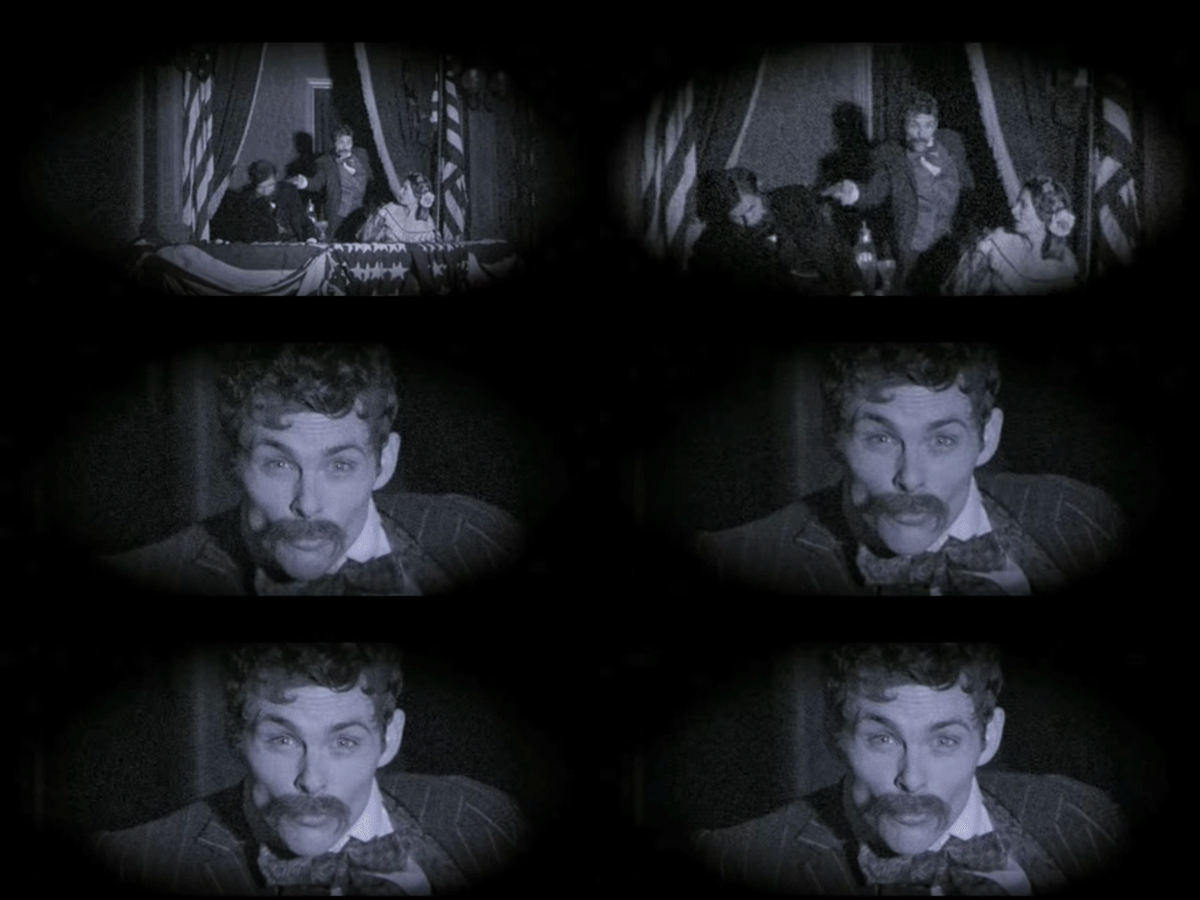
The movie’s lore reveals that fashion has been behind every head of state assassination since the beginning of time, and while I’m totally willing to hear the writers out on their red string diagram of that sometime, it’s only somewhat true in real life.
The garment industry has indisputably had a major influence on geopolitics throughout history. Sven Beckert’s book The Empire of Cotton chronicles cotton as essentially the driving force behind the Industrial Revolution, global slavery, and labor movements. Today, fashion is the second most regulated global industry apart from agriculture. Remaining American cotton mills have exerted much influence over our clothing tags and the policy stitched within them.
Though ever-shifting, Pietra Rivoli chronicled some of these insane rules in 2008 in The Travels of a T-Shirt in the Global Economy. To qualify for duty-free import to the US, countries have had to meet different manufacturing requirements for different categories of garments, such as the use of American spun yarn or American finished fabric, even when manufactured abroad. There was even debate over “pocketing provisions” that would extend the requirement of American made fabric beyond the denim in jeans, to the materials of the pockets as well. My favorite quote from the book reads, “Special rules are in place for Honduran socks.”
And despite every president since World War Two purporting the vision of “free trade,” most have had to compromise that ideal and impose trade regulations to to win the votes of largely Southern American garment and textile workers. Not only that, “the United States can dangle the carrot of free access to the U.S. market as a tactic to win over important friends, and indeed to negotiate for favors completely unrelated to trade.”
For example, in the days following the September 11th attacks, while most sensible patriotic Americans were in the theater watching Zoolander, parties at the highest level of federal government were negotiating a loosening of tariffs for Pakistani textile imports to bolster Pakistan’s solidarity with the US in the ensuing war on terror.
So yeah, the use of textile trade policies as foreign policy chips combined with the fact that the fashion industry is basically capitalism personified makes it hard to believe there hasn’t been direct connections to the assassinations of world leaders, as there are in the movie.
2. The Ruthlessness of Lower Wages
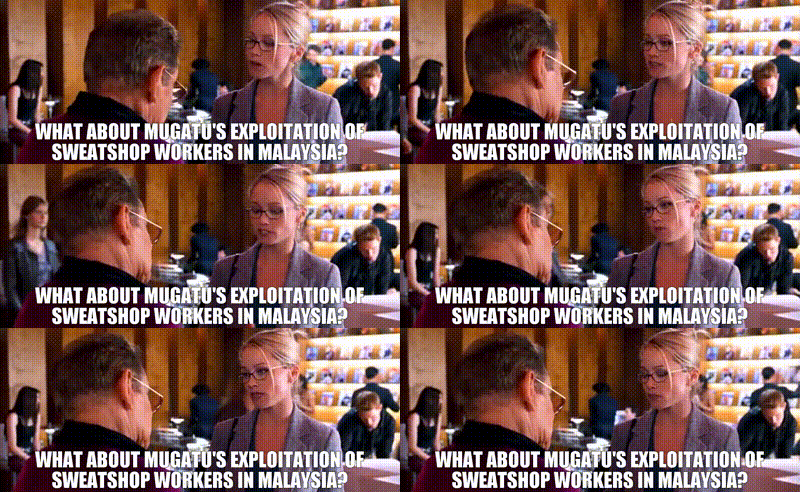
The increasingly volatile race to the bottom for outsourcing labor with the lowest wages has only gotten worse since the film hit theaters in 2001. Between 2000 and 2007, over half of US textile jobs were lost overseas to lower and lower paid workers, first in East Asia and increasingly in South and Southeast Asia. With lower wages comes worse and worse conditions as well.
Did you guys know about Rana Plaza in Bangladesh in 2013? A building housing 5 garment factories collapsed, and 1,132 people died, including children! I was alive and coherent then, this was basically half of 9/11 in a different country, and I just never heard about it. Btw Walmart was reportedly “surprised” to find their labels among the rubble at Rana Plaza, which is about as surprising a fact as if you told me Zoolander’s Magnum was going to be the same face again.
In the midst of the 2020 Covid-19 pandemic, it was revealed that companies had refused to pay for $40 billion in orders to garment factories, some already made and shipped, due to a slash in demand. Breaking unenforceable contracts and sending millions of garment workers into unemployment globally, this prompted the #payup movement during which several brands reversed their course.
Since Zoolander + co save the day in the movie, I’m choosing to believe that none of these awful tragedies happened in the ZCU (Zoolander Cinematic Universe).
3. People or Products?
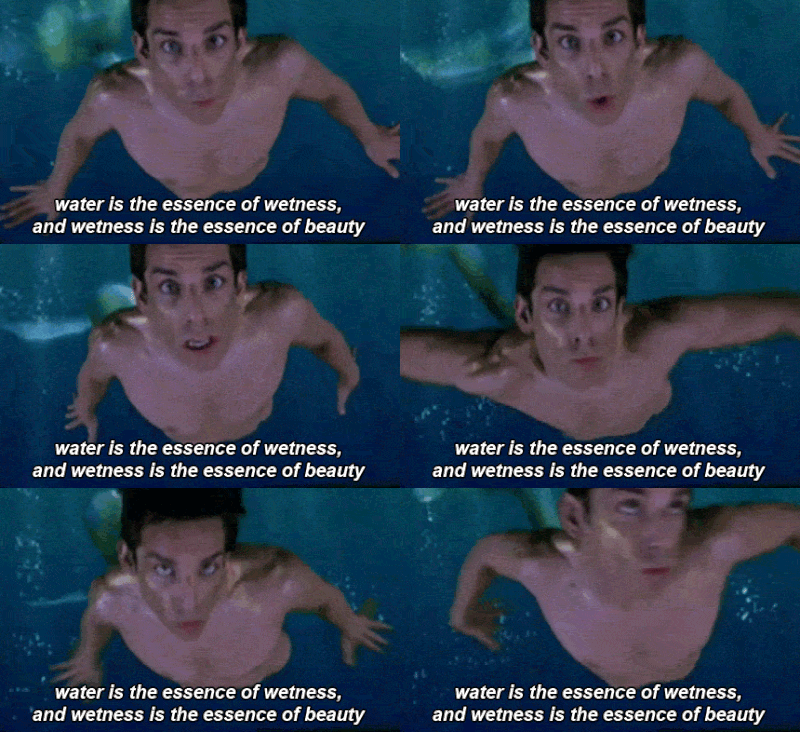
One theme exaggerated in Zoolander that has further infected our minds since is the commodification of people and their use in advertisements. Even more so than the models in the movie, today’s influencers serve as empty vessels to be adorned with sellable products.
While Zoolander mostly detailed the effects through the era’s lens of billboard, print, and television, corporations today have become increasingly manipulative and less transparent through the online medium.
They have parasitically infiltrated the convenience, accessibility, swipe-uppability, link clickability, and ubiquity of the instagram economy that has Stockholm syndromed many of us into believing that the calculatedly fake lifestyles we yearn for can be achieved by owning enough things. As a result, it is easier than ever to make a career out of what is basically being a glorified salesman (though influencing is one of the only careers in which women make more than men).
Gone are those good old days of supermodels in magazine ads. Their nepotism celebrity daughters, YouTube stars, even micro influencers you actually went to high school with have compromised their authenticity with #ads.
I’m not dragging models and influencers per se, and I’m the first to admit that I own literally an absurd amount of products that I saw a pretty girl online use, that sit gathering dust in my apartment because shockingly my bone structure didn’t transfigure itself into Madison Beer’s after one use. I’m simply commenting on the depth to which we have let consumption enter our psyches.
While it was clear that consumers who bought products from Zoolander ads ought to be aware enough that he was a sellout, I’m not quite sure we as consumers can draw that conclusion as effectively today.
4. The Cameos…
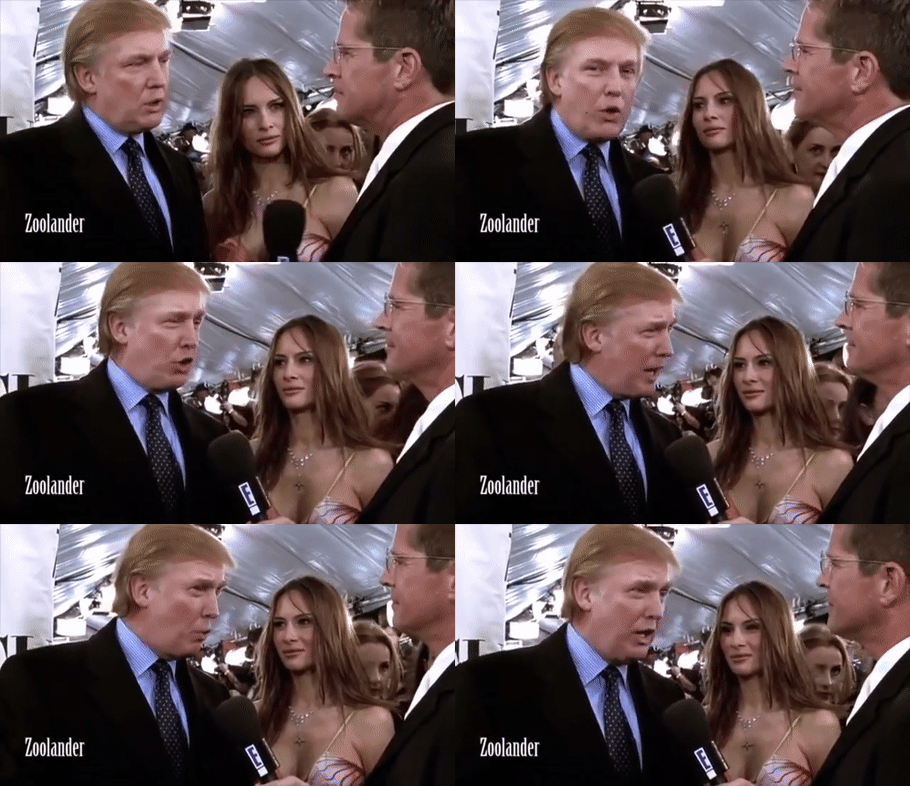
Okay I kind of feel like the cameos in this movie didn’t age well. They show a multitude of designers and celebrities from Tom Ford to Paris Hilton ringing Zoolander’s praises.
In a Women’s Wear Daily article I read recently, responses were collected from big fashion industry names on the light speed velocity of the fashion industry today, referring to the increase in the number of runway shows each year, the heightened turnover of trend cycles, and the expansion of vast clothing landfills like those in the Chilean Atacama Desert.
Tommy Hilfiger gave some bullshit answer that comes off as a flex that he knows Kendall Jenner and Gigi Hadid. Donatella Versace was similarly giving tone-deaf as she stated “If you complain about the pace of fashion today, you are closing the door on the future of fashion,” followed by, “The doors of fashion are opening up so everyone can feel part of a global tribe.” Ew.
I know I have the unfair lens of having watched the movie after reading their statements, but it just seems a little counterintuitive to have been featured in the critique on vapidity and literal fast fashion that was Zoolander and then say those things.
Also, I know that one of the horrifying things about Trump being president was that he was a TV star prior, but it’s still weird that Trump is in it.
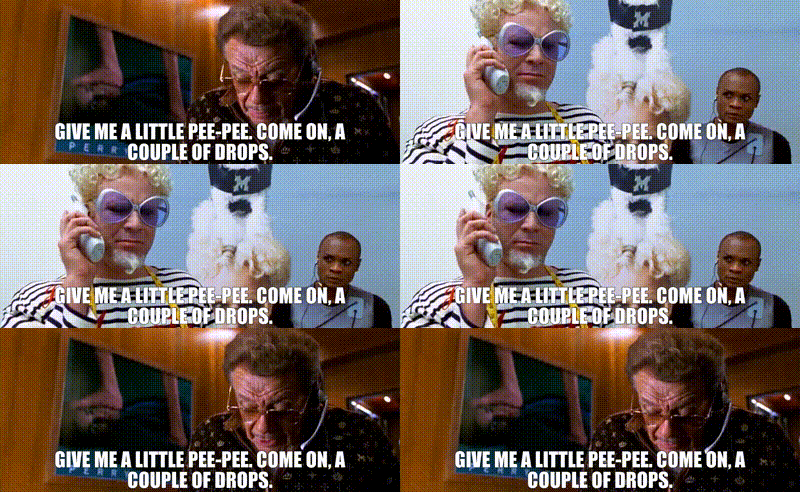
5. What The Hell, Maury?
There are two separate occasions in the movie when Zoolander’s agent, played by Jerry Stiller, assaults his much younger female employees.
This calls to question: If Zoolander and the crew effectively dismantled global capitalism earlier (that’s canonical), would the #MeToo movement even have happened? And does that mean Ben Stiller’s dad is still roaming around as an unscathed predator somewhere in the ZCU?
6. The Climate Change Implications
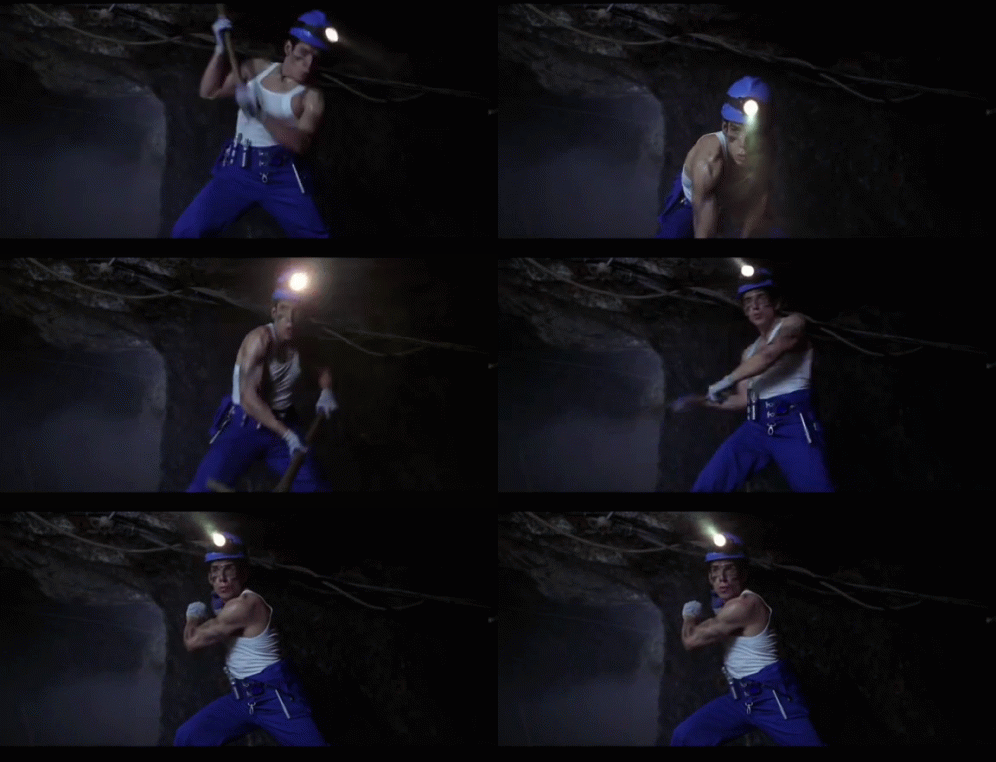
This is the most smoothbrained out of all of my points but here I go anyways. In the film, Derek comes from a family of coal workers. Not sure why I haven’t referred to Zoolander as Derek this whole article but that’s his first name.
The characterization of his family when he returns home implies a sort of lack of progressiveness and residual bitterness against implicit globalization that has left their coal town decrepit. Not understanding Derek’s urban coastal elite lifestyle, they insult him, eventually propelling him back to his modeling career and landing him with the task of assassinating the Malaysian Prime Minister.
This segment of the movie is a dangerous piece of propaganda, in that it advances the trope that coal workers are A. plentiful and B. unable to adapt to modernity.
In a podcast on political communications featuring Anat Shenker-Osorio, she revealed that Americans overestimate the size of the coal industry and the number of jobs it encapsulates. This subsequently overstates the importance of coal to the economy, and slows the ability to shift to renewable resources for fear of devastating this fairly small segment of society.
What’s more, the movie doesn’t even attempt to provide a practical solution for Derek’s family other than gaining pride for their metrosexual relative. When Derek has his big break and his family watching from his hometown bar are suddenly proud of him, the film purports the narrative that mutual cultural understanding is what is needed to lessen the burden of an oppressive fossil fuel regime.
This take is even staler today as culture wars have burgeoned on as resolutely as fossil fuel plants over the past two decades, with workers receiving no clear alternatives as their bosses’ and their bosses’ bosses won’t even acknowledge a problem.
I could delve into the symbolism of the freak accident that causes Zoolander’s entire leather-clad group of roommates to LITERALLY DIE in a gas station explosion, but I digress.
Overall, I almost didn’t write this article because of how salient the lessons felt in our modern era. I’m a little disappointed I couldn’t watch this as a child in ignorant bliss of the global economy because honestly, the political ramifications are more vulgar than even the weird orgy scene.
What distresses me is the wide time jump between Zoolander (2001), and its 2016 sequel. I know I will have to watch it and contextualize it with the concurrent primary ramp up to the 2016 election, but despite how much I love Owen Wilson, I simply think it will be cringe.
Thank you R, for letting me indulge in the wonders of childhood, even as my poorly functioning cynical brain ruined every second of it.
Can guarantee Meet the Fockers is not suitable for kids but it may be a good movie for you to see if you want to draw comparisons to the real world CIA
Loved this Article, F. When I first watched Zoolander as a preteen, I thought it was extremely wacky! Watching it now, I feel that it mirrors our 2022 reality. In the early 2000s it felt like a parody, now it just feels pretty accurate. :/ Someone please watch the sequel with me.